AI in Advertising
Ten years ago, advertising was done in a very hands-on manner, choosing demographic factors, changing the ad copy, etc., and waiting for the results of successful PPC campaigns to return success. Fast forward to 2025, and we have seen the rise of AI in all aspects of advertising. AI will no longer be a necessary resource for marketers to learn and use; instead, AI will become the primary driving force and tool used to direct ad strategies through the process of developing smarter bid and audience methodologies. Advertising will also benefit from personalization, timeliness, and efficiency, along with scale. In this article, I will explain how artificial intelligence is changing digital advertising, its positive and negative effects on the PPC landscape, and how we will see the future of PPC shift from a “set it and forget it” to a “set it and monitor it.”
Also Read: AI in Digital Marketing: How Artificial Intelligence Is Transforming the Entire Industry
AI in Digital Advertising
Digital advertising uses machine learning and AI in multiple applications. Whether it’s paid search engine ads, social media ads, display network/media ads, etc., the days of blanket targeting using broad categories and fixed prices are gone. Today, all things digital are done in real-time with predictive data insights and dynamically changing campaign content.
Digital ads utilize machine learning and AI technology to understand how users are behaving, where they are located, and what they want at that moment to determine who should see what ad and when, and which version(s). The transition from static ads to dynamic, growing campaigns is where digital advertising has taken its greatest transformation through the use of machine learning and AI technologies.
Businesses gain twofold from this evolution: better advertising performance through improved marketing automation efficiency and efficacious marketer work processes. Rather than utilizing a few ads and manually monitoring them, advertisers are now utilizing dozens (or hundreds) of ad variations that continue to improve automatically based on which Ads perform best, and, in the remaining time, to allow the creative minds behind the advertisements to focus on creative development, brand development, and overall marketing strategy.
Also Read: How AI is Reshaping the Digital Marketing Landscape
AI PPC Management
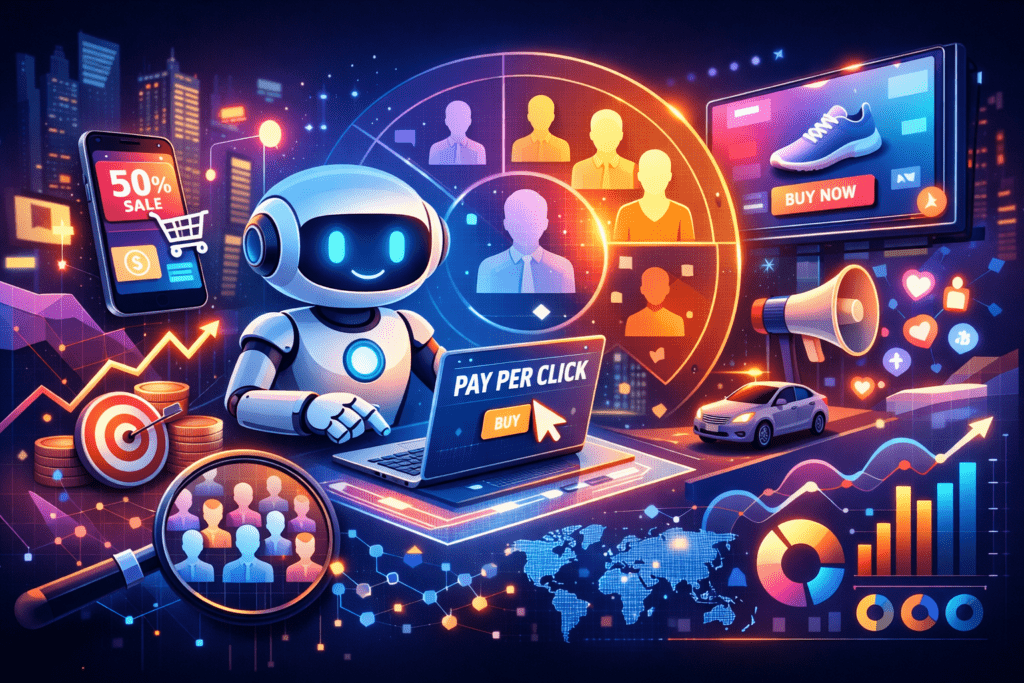
The management of PPC campaigns using AI (artificial intelligence) is known as AI PPC Management. Bidding automation, budget distribution, ad testing, etc. are managed by AIs in near-real-time through bidding automation, budget distribution, ad testing, etc.
PPC managers historically had to determine the best bid for every campaign based on historical data and the best possible budget based on what they thought would work best. After determining bid amounts, the managers would go back and manually update campaigns if they felt they were not doing as well as anticipated. This process is reversed in terms of how AI PPC Management is conducted because AI machine learning systems are continually watching live data, specifically the number of clicks and conversions for each ad, and will optimize based on that data. For instance, the system will adjust bids automatically according to time-of-day or only as necessary according to device, user activity, and competition.
When an ad is producing less than anticipated, it can be paused or updated; when an ad is producing more than anticipated, it has more budget allocated to it.
The structure of the PPC Campaign can grow automatically without the need to manually copy and paste all the ad sets for each individual combination of audience and ad type.
A clear benefit of adopting AI PPC Management is the minimization of wasted ad spend and maximization of ROAS. AI tools have been shown to reduce costs per acquisition while simultaneously increasing conversions, according to industry experts.
AI does not replace the PPC manager’s role; it enhances their ability to be more efficient and effective in their work.
Also Read: Maximising Success: Effective Conversion Rate Optimization Strategies
AI in Paid Search
While the previous version of paid search relied on keywords and placements, predictive analytics and real-time data enable advertisers to determine where to spend their dollars with an AI-powered platform.
In addition to providing a clearer picture of what an advertiser should be targeting, AI in paid search allows for the identification of user behaviour through various metrics. Behaviour includes how users search for queries, and what types of devices they use, along with when they demonstrate an interest in converting.
By using the aforementioned data points, predictive analysis can determine which searches have the best probability of making a successful conversion, thus optimising advertisements towards those users.
Ultimately, this technological improvement allows paid search campaigns to evolve from ‘spray and pray’ tactics to a more effective ‘precision strike’ method of targeting. Instead of bidding on keywords, advertisers can identify the intent behind those keywords. For example, if a user is searching for a product on a mobile device late at night, that user is more likely to complete a purchase than a user searching during the day from a desktop computer. AI adapts ad copy and bid amounts based on that information.
AI in paid search campaigns also speeds up the time it takes to conduct testing and optimisation. Advertisers can simultaneously run multiple iterations of an ad copy, landing pages, or bidding strategies, while AI uses real-time data to evaluate those iterations and redistribute the budget to the best-performing campaigns, with no manual oversight.
Because of these factors, advertisers using AI in paid search benefit from greater ad relevancy, elevated CTRs, and improved conversions. Thus, using AI in paid search is not just the future; it is already a reality.
Also Read: Top Benefits of Pay Per Click (PPC) Google Ads | From Clicks to Conversion
AI in Google Ads
If you use search ads, there is a good chance that artificial intelligence (AI) exists within your campaigns even if you are not aware of it. Google Ads and other platforms have incorporated many machine-learning tools into Google Ads, including Smart Bidding, dynamic ad generation, and automated audience targeting. These tools automate the ever-present “mundane but critical” activities associated with campaign management.
Here are some ways that AI is present in Google Ads:
1. Smart Bidding and Budgeting
Google’s AI will automatically change bids in response to factors such as conversion likelihood, mobile device, location, previous user behaviour, and many other factors. Google automatically distributes budgets where they are likely to have the most impact.
2. Responsive Ads and Creative Optimization
With Google Ads, you do not have to create just one ad but can provide multiple headlines, descriptions, images, etc. Google’s AI will then evaluate all of the ad components and determine the best combination to show each end-user. Google’s AI is also optimised for search relevance and advertiser success.
3. Automating Cross-Channel and Cross-Format
Whether the ad is running on search, display, or video, Google’s AI will help provide consistent targeting and provide a unified means of tracking results across different formats.
With these abilities, Google Ads suggests that advertisers no longer need to micromanage their campaigns. How? By defining campaign goals, determining the intended audience parameters, establishing budgets, and allowing Google’s AI to perform the work!
Also Read: Local SEO Markеting: A Step-By-Step Guide to Boost Your Businеss Locally by Google My Business
AI Audience Segmentation
The biggest way AI has changed how we understand audiences in advertising is through audience segmentation based on data collected through artificial intelligence.
Rather than simply grouping people into a small number of categories like “men or women, aged 25-34,” AI analyzes a much greater diversity of “big data” relating to audience purchase behaviour, past history, intent, engagement signals, etc. It builds upon this by grouping its analysis into micro-segments that are continuously changing.
The following examples show the practical use of AI audience segmentation:
- Instead of classifying individuals simply as “women aged 25 to 34”, AI will cluster them based on their micro-segment classifications, such as “mobile users who have browsed for shoes three times in the last week but did not purchase”, or “desktop users who have visited the pricing page and left after 20 seconds”. Each micro-segment is assigned different creatives, bids, and offers.
- AI enables advertisers to find “lookalike” or prospect audiences, users who have not yet interacted with your business but who are acting in a way that is similar to high-value customers. By expanding the audience for your message without providing an equal chance of conversion, AI enables advertisers to increase their overall audience reach through the development of micro-segments.
- Audience segments are automatically updated in real time, so if a customer abandons a shopping cart, accesses your pricing page, or begins to express purchasing intent through searches on competitor websites, the audience segment that your ad appears within will change, and your ad will adjust. With this dynamic segmentation, your ad targeting is significantly more relevant and reduces your total ad spend.
AI audience segmentation transforms the advertising business by providing advertisers with access to more granular data about audience behaviour and potential customers, resulting in substantial increases in ad relevance and cost savings.
The Future of Digital Ad Campaigns with AI
Over the long term, we see AI in PPC Management, AI in Paid Search, AI in Google Ads, and AI Audience Segmentation all working together, and we see these new trends continuing to positively shape the future of digital advertising:
- Hyper-Personalized, Real-Time Dynamic Ad Experiences: Ad creative and strategy will best fit each user’s behaviour, life cycle, and context in as many ways as possible (i.e., adapting continuously while users go through their journey).
- Cross-Channel Unified Campaigns: As AI continues to develop, it will enable advertisers to manage and track all advertising channels (search/social/TV/video/print) within one platform, allowing an easy-to-use, seamless, ubiquitous user experience from beginning to end.
- Automation Driven by Performance/Minimal Overheads: Local entrepreneurs, small business owners, and charities who may not previously have had the man-power to conduct sophisticated advertising campaigns will benefit; AI will manage the sophisticated complexity of the ad campaign for them, leaving them only to determine the outcome and what method of execution they would like to pursue.
- Ethical AI and Privacy First Methods of Targeting: As global regulatory requirements and posture continue to tighten, the increasing requirement for all companies to practice ethical and compliant behaviour will drive innovation in advertising; data-driven AI will drive the need for ethical, privacy-compliant advertising.
- The Creation of Hybrid Workflows Between Creative and AI: Human creativity and AI-powered automation will work in tandem to develop innovative work products (creative developed by humans; testing and scaling automated by AI); this will lead to more efficient and successful advertising campaigns without compromising the voice of the brand.
Therefore, the advertising industry will move toward a hybrid model created from a partnership between AI (for scale, speed, and data) and humans (to develop strategies, ethics, and creativity).
Also Read: Top 6 Useful Metrics of Email Marketing
Final Thoughts
For marketers, agency leaders, business proprietors, or individuals with an interest in the future direction of advertising, it’s essential to keep pace and take advantage of AI in Advertising today!
This transformation has moved from being incremental to structural. Instead of taking hours of labour-intensive tasks, now technology has allowed us to perform these tasks in a matter of minutes or seconds. Rather than making broad audience assumptions on previous campaigns, technology has allowed for nuanced behaviour-based targeting of each individual consumer. And no longer is it necessary to guess in what direction to take; data-driven logic combined with real-time learning provides direction.
Incorporating AI PPC Management (Pay-Per-Click), incorporating AI into Paid Search Advertising, taking advantage of AI in Google Ads, utilizing AI Audience Segmentation, will not only help in optimizing your current PPC campaign through more efficient ad placement and audience targeting, but it will also help create smarter, leaner, and far more effective ROI-based advertising platforms.
Always view things from a balanced perspective; while AI may help you generate additional revenue through AI technology, you should continue to exercise your inherent creativity, nuance, and human judgment, and take your ethical obligations seriously.

Pradeep Jade is a seasoned digital marketing consultant with over 20 years of experience across the market. He has helped businesses unlock sustainable growth in an ever-changing digital sphere. He is known for blending strategic insight with cutting-edge tools and technologies. He uses his vast experience to design result-driven marketing solutions that accelerate brand visibility, lead generation, and revenue growth. Book a free consultation with him to explore how you can take your business from 2X to 10X.