AI in digital marketing
Digital marketing used to mean writing a clever slogan, designing a flashy banner, or spending an exorbitant amount of money on ad space and hoping that the right people saw it. But that has all changed with the advent of artificial intelligence (AI). In other words, marketers now have tools that can process enormous data sets, learn patterns from the behavior of those receiving the messages, tailor on-the-fly messaging to users, and optimize campaigns on a near real-time basis. In this blog post, we’ll dive deep into how AI is transforming digital marketing: what it does today, where it’s heading, and what that means for brands, marketers, and consumers.
Role of AI in digital marketing
At the core, AI in digital marketing functions as part-brain and part-helper. It powers user data, reads users’ behaviors, and enables marketers to make smarter choices, much faster than a human could. For instance:
- AI-based predictive analytics predicts customer preferences, potential trends, and the best time for campaigns to put marketers ahead of demand rather than behind it.
- AI chatbots and virtual assistants provide customers online support in real-time, including answering questions around the clock, recommending products, and assisting them with their purchases or problems.
- On the content and communication side, AI tools help build, curate, and optimize marketing content, from social media posts to email campaigns to website copy.
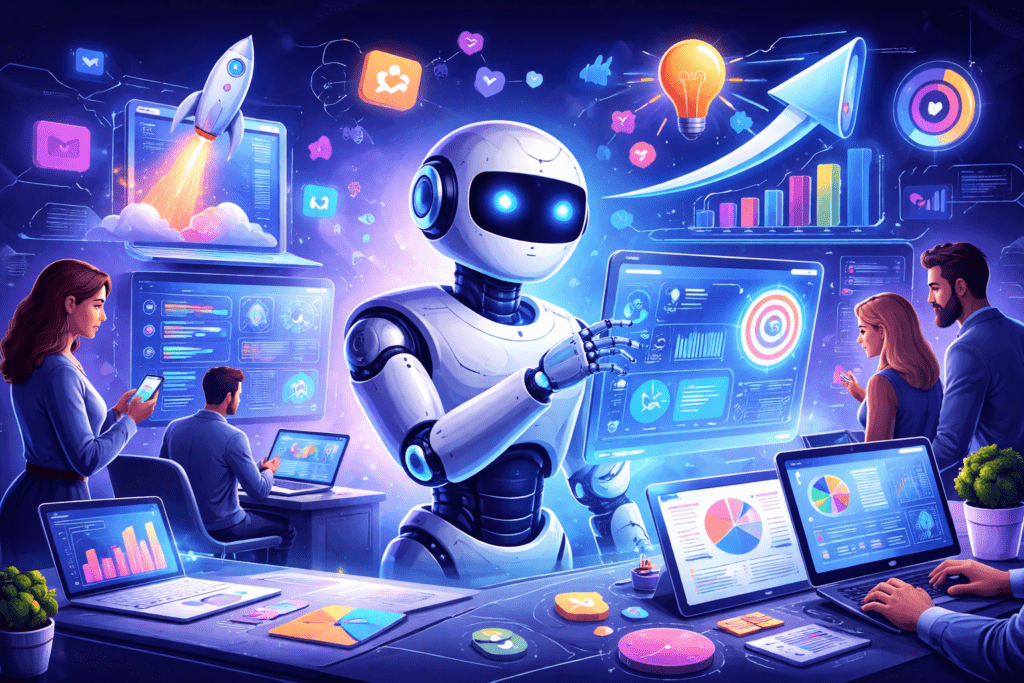
AI serves as a sort of jet engine behind many moving parts in digital marketing, from content to data to customer interactions.
Also Read: AI in Advertising: How AI Is Transforming PPC Management, Audience Segmentation & the Future of Digital Ad Campaigns
Future of AI in digital marketing
AI in marketing is changing fast and looks good for the future. Because AI is getting better every day, especially with things like generative AI and data analysis, here’s what we might see:
- Hyper-personalization at scale: AI will get way better at making custom content using things like age, habits, and real-time info. So, companies could make experiences that feel just right for each person.
- Self-running campaigns: AI might not just suggest campaigns. It could make them, test them, and make them better all on its own. This means it would pick where to put ads, who to show them to, what to say, and even change the budget as needed.
- Better Predictions: As AI gets better at understanding data (like feelings, images, and what people say), marketers can make smarter choices. They can spot what’s current before it happens, change faster, and stay ready for anything.
- New Technology: When you mix AI with things like AR/VR and voice search, you can create user experiences that really pull you in, and feel super smart and alive, way past simple ads and emails.
Benefits of AI in digital marketing
There are many advantages of using Artificial Intelligence in your digital marketing efforts, such as:
- Automation & Efficiency: Automation of repetitive or time-consuming tasks (e.g., scheduling social media posts, sending emails, analyzing campaign data, responding to customer questions, etc.) allows marketers to focus on creative and strategic marketing tactics rather than on tactical planning tasks.
- Scalability without proportional cost increase: With the ability to manage large volumes of information using AI technology, organizations of any size (small startups to large multinational corporations) can expand their marketing efforts without a proportional increase in work/manpower or overheads.
- Better targeting and personalization: Utilizing the data analyzed by AI to understand users’ behavior, preferences, profile, browsing habits and engagement with the organization’s marketing efforts provides marketers with a higher chance of creating and delivering content that will engage and convert their target market at a higher rate.
- Data-driven decision making: Converting large, complex data sets into insights you can use to develop smarter and more effective marketing strategies based upon your results. Understand what content to create, what offers convert, and to what audiences, based upon the information the AI provides.
- Improved customer experience & response time: Providing real-time support via chatbots, dynamic content personalization, and by providing timely offers creates an environment where your customers feel seen and valued. Customers who feel that they are being supported in this manner will likely have a higher level of loyalty & satisfaction, therefore, increasing your ROI.
These benefits make AI an especially attractive option for brands looking to stay competitive, especially in crowded, digital-first marketplaces.
Also Read: How AI Overviews are changing SEO strategies
Use of AI in digital marketing
Artificial intelligence is changing the world, including the world of digital marketing. AI is able to analyze data, predict trends, and automate processes. AI is now an essential tool for marketers. In case you want to enhance your strategies as a marketer and deliver more super-personalized experiences to your customers, AI is the way to go.
Where is AI present in Digital Marketing? Below are common examples of where and how AI is applied:
- Chatbots & Customer Service Tools: In addition to providing 24/7 service availability, chatbot technology enables companies to free up their employees’ time by providing assistance to customers when required.
- Content Creation & Optimization: Companies utilize AI technology to assist them in developing all types of content, including blogs, social media posts, email copies, and product descriptions. Furthermore, the AI tools will also optimize the content for Search Engine Optimization (SEO), readability/the level of writing, and the engagement level of the targeted audience.
- Predictive Analytics & Forecasting: AI is utilized to analyze past behaviour of customers and to examine external market data, and to forecast which content will receive the most response from customers, and at what point in time, and why customers would respond to that specific content.
- Personalized Campaigns & Recommendations: AI is used by e-commerce platforms, content, or service suppliers to support their customers with personalized recommendations such as specific products, content, or offers. This enhancement of user experience makes advertisements and promotional items more appropriate to the targeted audience.
- SEO, Search Intent & Content Strategy: Additionally, AI tools help improve and refine content to be more search engine optimized through keyword selection, segmentation of metadata, understanding intent by user intent, assisting with internal linking, etc., making it easier for users to discover and utilize this content.
- Ad Targeting and Programmatic Advertising: AI allows for the management of all facets of an online marketing initiative via artificial intelligence by aiding in organisational placements, bidding strategies, audience targeting, and real-time modifications based on user behaviour patterns. These tools improve both the efficacy and the effectiveness of digital advertising campaigns.
Together, these tools demonstrate that artificial intelligence is applicable to more than one singular marketing function; rather, artificial intelligence comprises all areas throughout the marketing funnel, from initial product awareness through developing content, through customer service, and ultimately customer retention and loyalty.
Also Read: How AI is Reshaping the Digital Marketing Landscape
Impact of AI in digital marketing
Artificial Intelligence has touched every industry and every company in some way, and no less than the following examples show how Artificial Intelligence is changing the digital marketing landscape.
- Democratization of sophisticated marketing for smaller businesses: Through AI’s power, smaller businesses are now able to enter the marketplace with much less difficulty. With AI tools, small businesses can run customized marketing campaigns and use tools such as customer service automation and data analysis.
- Faster decision-making and agility: AI provides fast decision-making capabilities for marketers in reference to shifts in customer behavior and market trends, allowing for quick adjustments of ad campaigns, timely content updates, and immediate ability to launch offers. The flexibility provided by these types of capabilities gives brands an edge in rapidly evolving digital environments.
- Improved customer relationships and loyalty: Customization allows for stronger relationships with customers, and therefore additional opportunity for loyalty. Personalized interactions through timely support and relevant content generate feelings of being understood and valued, as well as creating a trustworthy atmosphere for long-term engagement.
- Cost and resource optimization: By automating repetitive tasks and removing manual workloads, businesses realize cost savings in time-to-market, as well as a decrease in the amount of human resources needed to complete work for any business.
- Better measurement and performance tracking: Data-driven artificial intelligence tools allow brands to more accurately measure their campaign performance, customer response rates, and engagement metrics, as well as provide brands with more transparency for measuring roi on their marketing strategies.
Altogether these effects are re-defining how brands will view digital marketing in terms of strategic value, transitioning from being an integral component of revenue generation and customer engagement through data-driven intelligence.
Also Read: How AI Overviews are changing SEO strategies
Advantages of AI in digital marketing
There are so many benefits of implementing AI in digital marketing that are already mentioned in this blog. Let’s take a look at some specific advantages of AI in digital marketing:
- Speed & Efficiency: With the benefits of artificial intelligence comes increased speed (for example, through repetitive task automation) and as such marketers are able to bring their messages, campaigns, customers, and all else to market at a faster rate than before.
- Precision & Personalization: Due to the ability to create personalized messages and target specific customers, customers receive more relevant information and ultimately are more willing to engage with your brand.
- Cost Overall: By eliminating a majority of manual processes through automation, marketing will have the same amount (or more) of resources to accomplish all of the same tasks.
- Scalability: As previously stated, automation gives you the ability to build marketing programs at a scale that you may not currently be able to support.
These benefits position AI as an advantage to marketers in a rapidly changing and competitive world filled with overwhelming amounts of data.
Also Read: What is generative engine optimization & how does it work?
Will AI replace digital marketing in the future
This is a good question to be asking, and it’s definitely timely given how quickly technology and artificial intelligence are developing. But in short, the answer is: No, not entirely.
Here’s why:
- While A.I. can automate some aspects of marketing, it is not only data-driven and efficient; marketing is also about understanding people through culture, emotion, context, creativity, and empathy. Automated tools might assist in creating ads or content, for example, but usually they lack the creativity to create an emotional connection with their audience. Creative industries’ studies indicate that the primary advantage of A.I. is as a support of human creativity; it enhances rather than replaces human creativity.
- Ultimately, effective marketing requires human judgement, especially with regard to brand voice, ethics, and storytelling; AI simply provides marketers with data and options. Marketers use their intuition, the knowledge gained through marketing experience, and their instinctive “gut” feelings when determining the best choice of action regarding what is suitable or acceptable for the brand.
- Although AI tools are extremely powerful sources of information, the reliance on high-quality data is a critical factor in their ability to produce quality outputs. When data has bias, is out of whack, or is not properly validated, this causes AI-produced output (whether or not these outputs are content or recommendations) to potentially produce bad results. Over-relying on AI may lead to developing marketing pieces that may appear to be bland, formulaic, or possibly have incorrect information; hence, there will be marketing pieces that fail to distinguish themselves from other marketing pieces.
AI will change digital marketing and, therefore, how the business operates, at what speed the business operates, as well as the tools utilised to operate the business. This may cause marketers to transition away from being content creators and campaign managers, towards being strategy architects, ethical storytellers, and brand custodians; with respect to marketing operations, AI will act as the primary day-to-day operational tool used by marketers.
Final Thoughts
There is an interesting change going on currently with regard to how businesses communicate, sell, and create connections with their audience through marketing. The evolution of artificial intelligence is allowing businesses to execute digital marketing at a much greater speed than before, and make it more intelligent and personalised than it has ever been. Businesses now have access to powerful tools such as chatbots, predictive analytics, hyper-targeted digital campaigns, and content creation, and these tools continue to improve with time.

Pradeep Jade is a seasoned digital marketing consultant with over 20 years of experience across the market. He has helped businesses unlock sustainable growth in an ever-changing digital sphere. He is known for blending strategic insight with cutting-edge tools and technologies. He uses his vast experience to design result-driven marketing solutions that accelerate brand visibility, lead generation, and revenue growth. Book a free consultation with him to explore how you can take your business from 2X to 10X.