Dwell Time in SEO
Dwell Time is the term used to describe the amount of time a visitor spends on a website after clicking from a search engine page before returning to the search engine results page. SEO marketers and site owners have argued about dwell time for years, and today, although Google does not specifically say anything about Dwell Time, this metric still can indicate whether or not your content is holding users’ attention.
In this guide, we are going to explain exactly “what is dwell time in SEO?”, why it has been gaining increased importance over the last few years, and what types of strategies can impact dwell time.
Also Read : What is Inbound Marketing and Types of Inbound Marketing
What is Dwell Time in SEO
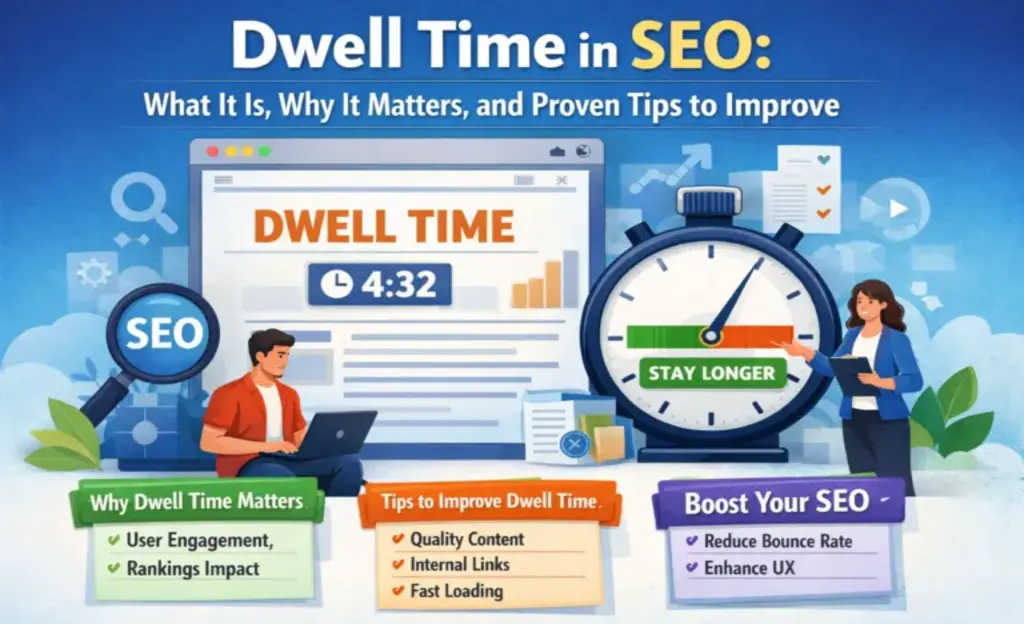
What Is Dwell Time in SEO? It refers to how long a user stays on your site after clicking on the link in the search results before returning to the search engine results page.
Dwell time is not something Google has officially reported to be an indicator for ranking purposes, but many SEO Experts (like Moz and Search Engine Journal) think it may be a significant indicator of quality. In fact, Moz founder Rand Fishkin ran an experiment proving that the longer the dwell time from a particular page, the better the chance that page will be ranked on the first page of Google.
The more time a user spends on your page, the more likely they are to have found your page the most satisfactory option to the search they did. Dwell time is unique from both average time on the page and the bounce rate.
Average time on a webpage measures how long someone spent reading your page, whereas Dwell Time measures how satisfied a user was with the content they found. In addition, average time on page includes traffic from all of your marketing channels and paid search traffic; Dwell time is specific to users who clicked on your website after conducting a search.
On-page Engagement Tips
Understanding how visitors interact with a website is the first step in developing an effective strategy to increase their time on site (also known as dwell time). Users who are engaged with a website’s content tend to remain on that page longer. The primary purpose of the on-page engagement tips is to increase the length of time users will spend reading your website’s material.
Here are five examples of proven on-page engagement tips that work for all types of businesses:
1. Craft a Compelling Introduction
Studies show that users have made up their minds about whether to read your article within just a few seconds of landing on the page. A compelling hook, relatable anecdote, or brief story can help drive traffic to your page quickly.
2. Divide Content Into Digestible Pieces
Large chunks of text can be overwhelming for visitors. By using appropriate headers, lists, and graphics, readers are able to read without strain and find relevant areas of interest.
3. Include Relevant Visual Media
Charts, screenshots, infographics, and tables of comparable products or services provide the necessary context for your article. Random stock photos simply take up space without adding value.
4. Use Internal Links Wisely
Including relevant links throughout your article helps retain users on your website longer and increases their understanding of your website’s overall purpose.
5. Provide Quick Navigation Options
Long-form articles are more appealing to readers who can easily access particular sections without reading the entire article. Quick navigation options enable readers to customize their reading experience.
Also Read: AI in Digital Marketing: How Artificial Intelligence Is Transforming the Entire Industry
Content Engagement Metrics
Content Engagement Metrics should always be monitored as they provide insight into how well the content performed and also highlight areas that require improvement. These metrics inform us of an individual’s engagement level with the content, including when they lose interest and abandon it. More engagement means longer dwell times, therefore allowing more opportunity to establish E-E-A-T (Expertise, Continued Engagement, Authoritativeness & Trustworthiness).
The following metrics should be closely monitored:
1. Average Scroll Depth
The average scroll depth measures the total distance vertically that a user scrolls down a webpage. If the majority of visitors abandon the page before reaching halfway down, this indicates that there is potential for restructuring, clarifying, or improving the content of the top portion of the page.
2. Time on Page
The time on page metric provides a broader perspective of how engaging the content is to the reader. However, time on page is not the same as dwell time.
3. Internal Linking
Internal linking refers to how users interact with the various links within your website. If users do not click on internal links after visiting a page, then this means that there may exist an issue with the strategy used to create internal links, or they may not be relevant to the visitor(s).
4. Engagement with Video Content
If you have added any form of video engagement on your website, you should carefully measure both how many viewers have played the video and how many have completely viewed the entire video through to its conclusion. This will allow you to identify the types of videos that help to retain visitors, which can positively impact the overall length of time that visitors spend on your site.
5. Exit Pages
You can also look at which exit pages users are using to identify how they are exiting from your site. If users have exited from a specific piece of content and returned to SERP, this is a natural exit point for many users. However, if the user didn’t find what they were looking for in your content or if they found it confusing or poorly structured, this could also indicate that more work needs to be done to improve this type of content for better user retention.
Also Read: How Graphic Design Helps to Communicate Your Brand Better
How To Improve Dwell Time
Having discussed what it is and why it is important to improve Dwell Time, let’s look at ways to enhance it in the real world and see that it doesn’t require any technical tricks beyond simply making the user’s experience better.
Here are 5 tried-and-true strategies to enhance Dwell Time for your site, without adding expense or stress to your resources:
1. Be genuinely helpful to your readers.
Many articles provide little help; they just provide filler. Readers tend to remain on pages longer when content is genuinely helpful in solving a problem for that reader.
2. Optimize the content of your introductory and lead-in paragraphs.
If your introductory paragraph does not capture the reader’s attention, your dwell time will drop off very quickly. By writing a very compelling introductory paragraph, readers will continue to read and increase your Dwell Time as a result.
3. Enhance Page Speed.
According to research conducted by Google, a 2-second delay in page loading time may substantially increase your page’s bounce rate. Google shows that for each second of increased load time, your site’s probability of being bounced increases by 32%.
4. Eliminate Distractions.
If your site has excessive pop-up ads, obnoxious ads, or cluttered layouts, visitors will not be comfortable and will therefore likely leave your site. Readers should find your site to be a comfortable place to read content.
5. Utilize Topic Clusters.
When you create content that supports the surrounding pages within a topic cluster, the readers will naturally flow between these pages. As a result, it will help build user retention, and both user retention and rank stability are improved.
6. Use multimedia wisely
“Wistia reports that visitors to pages with videos stick around 2.6 times longer than visitors who do not see any videos. Videos, GIFs, and interactive tools amass viewer interest and create a “sticky” experience for visitors.
7. Improve your CTA
CTAs aren’t always about selling something. CTAs can also include calls to learn more, calls to explore related topics, or calls to use a tool. Using the right CTA allows visitors to stay engaged with your content.
8. Update old content
Search engines prefer newly created information over old, outdated material. By regularly updating old material, you maintain relevancy and increase the amount of time visitors stay on your website.
When you combine your understanding of visitor behaviour with the consistent application of these strategies, dwell time no longer feels like an abstract number; it becomes an integral component of your content marketing efforts.
Also Read: Effective Content Marketing Strategies to Grow Your Business
Final Thoughts
When all is said and done, dwell time in SEO is not about tricking Google, but rather delivering content to users that they will enjoy spending their time with. The moment you understand “What is Dwell Time in SEO”, you’ll stop searching for inexpensive tricks and hacks and start working to provide value, clarity, and a good user experience.
You have learned through reviewing “how to improve dwell time” that there is no substitute for authentic and helpful content. Google is becoming better at measuring user satisfaction through dwell time and other behavioral signals.
Remember that SEO is not only about algorithms; it also encompasses human psychology through storytelling and user experience. As long as your content connects with people, SEO will automatically improve as a result.